Skip to content

ChargeTeam 2026 Barometer of EV Charger Faults

First edition, November 2026. What 1,038 real EV charger repair call-outs show, in France and Belgium.

  • 1,038 repair call-outs completed from July 2025 to October 2026
  • 142 repair call-outs in October 2026, our monthly record (128 on average over the last 4 months)
  • 2 days median between the request and the call-out date
  • 79 French departments, and Belgium
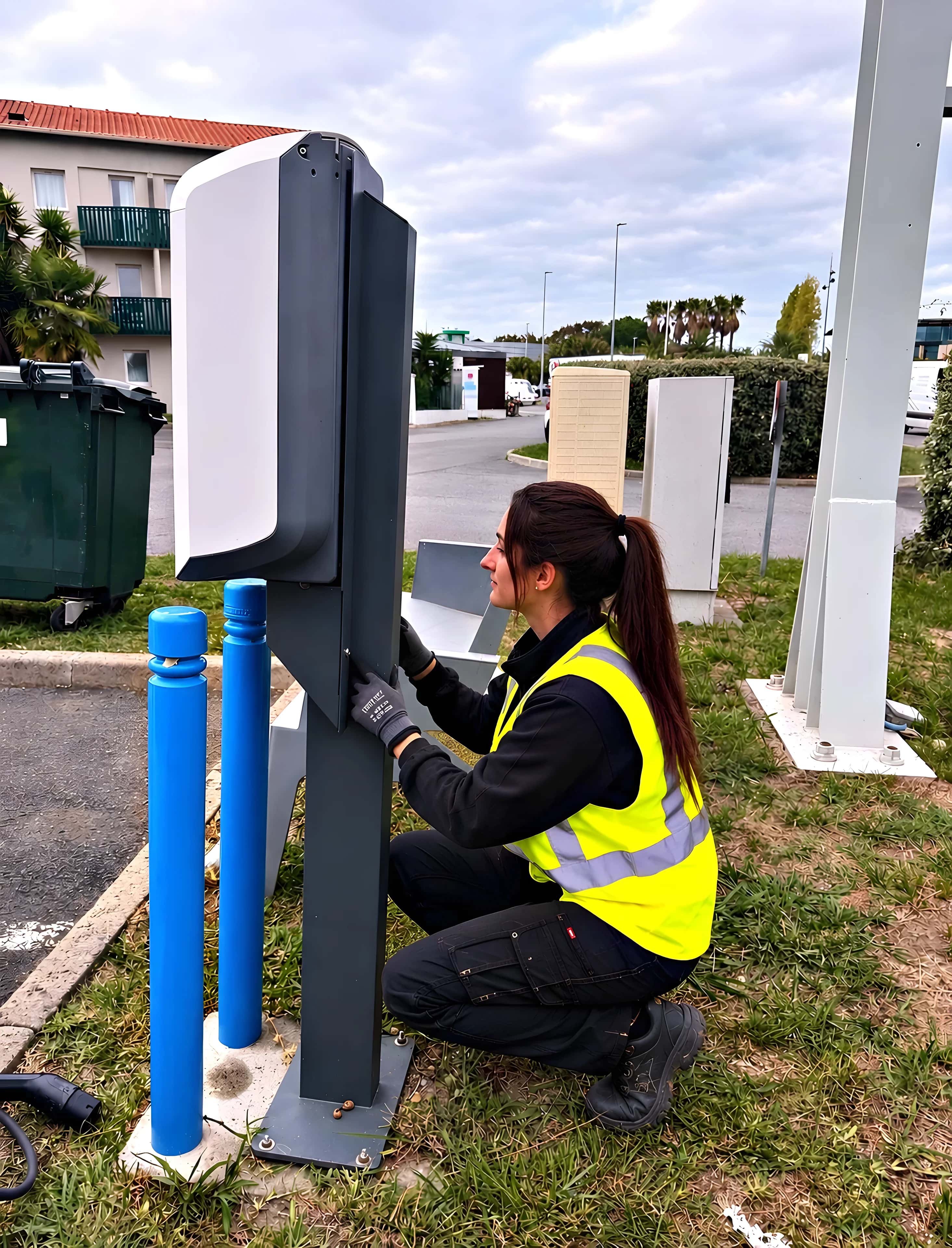
Technician in safety gear and high-visibility vest opening a charge point cover

EV charger fault statistics: the figures to cite

Each sentence stands on its own. The button copies the sentence with the name of the barometer, the year and the address of this page.

  • According to the ChargeTeam 2026 Barometer of EV Charger Faults, based on 1,038 repair call-outs, 41% of call-out requests concerned a charger reported offline.

  • According to the ChargeTeam 2026 Barometer of EV Charger Faults, based on 1,038 repair call-outs, 32% of the chargers attended were the subject of more than one call-out request.

  • According to the ChargeTeam 2026 Barometer of EV Charger Faults, based on 1,038 repair call-outs, 694 different chargers were attended from July 2025 to October 2026, in 79 French departments and in Belgium.

Charger offline, charger revisited: how often?

An “offline” charger no longer communicates with its operator’s monitoring system; depending on the model, it may or may not keep charging. It is the reason for 41% of repair requests, before it is even known whether the cause is a modem, a power supply or the charger’s electronics.

Of the 694 chargers attended, 32% were the subject of more than one call-out request over the period. A heavily used charger can have several unrelated faults.

Activity, month by month

Completed repair call-outs have multiplied by eight in fifteen months, from 17 in July 2025 to 142 in October 2026. At the pace of the last 4 months, that represents about 1,500 repair call-outs a year (a projection of the current pace, not an observed total).

  • Jul 202517
  • Aug 202527
  • Sept 202543
  • Oct 202529
  • Nov 202527
  • Dec 202523
  • Jan 202623
  • Feb 202622
  • Mar 202639
  • Apr 202671
  • May 202687
  • Jun 2026116
  • Jul 2026120
  • Aug 2026126
  • Sept 2026126
  • Oct 2026142

A larger public network, and above all a busier one

At the end of September 2026, France had 202,804 charging points open to the public, 13% more in one year and more than 300 points per 100,000 inhabitants. Each point was used on average 32.7 times a month, compared with 25.2 a year earlier. Points of more than 150 kW rose from 20,908 to 26,803, and electricity consumption at the points open to the public rose by more than 72%.

More sessions means more plug-ins, more heat and more wear on cables, sockets and electronics. Maintenance has to follow usage, not just the number of chargers.

Source: Avere-France and the French Ministry for the Ecological Transition, barometer of charging infrastructure open to the public (Gireve data), published on 12 October 2026 (in French).

The chargers we were called out to

Brands of the chargers attended over the period, with at least 5 call-outs. This breakdown reflects the networks that entrust their chargers to us, mostly fast chargers, and not the reliability of the brands.

  • Kempower300
  • I-Charging214
  • StarCharge196
  • Alfen109
  • Delta82
  • Ekoenergetyka65
  • Efacec35
  • IES15

Kempower, I-Charging, StarCharge and Alfen faults: what the requests report

For each brand with at least 100 repair call-outs, the fault as it was described in the request, before the technician’s visit. These chargers are mostly those of the fast-charging networks in France that entrust their maintenance to us: the breakdown describes what is reported, not the reliability of a brand.

Kempower

  • Charger reported offline39%
  • Connector or cable fault36%
  • Charger in fault or unavailable11%
  • Other request7%
  • Failed charging sessions4%
  • Not specified3%
  • According to the ChargeTeam 2026 Barometer of EV Charger Faults, based on 1,038 repair call-outs, for the Kempower chargers attended, 39% of requests concerned a charger reported offline and 36% a connector or cable fault (requests received, not the reliability of the brand).

I-Charging

  • Connector or cable fault49%
  • Charger reported offline30%
  • Charger in fault or unavailable8%
  • Other request8%
  • Failed charging sessions3%
  • Not specified2%
  • According to the ChargeTeam 2026 Barometer of EV Charger Faults, based on 1,038 repair call-outs, for the I-Charging chargers attended, 49% of requests concerned a connector or cable fault and 30% a charger reported offline (requests received, not the reliability of the brand).

StarCharge

  • Charger reported offline44%
  • Connector or cable fault26%
  • Charger in fault or unavailable17%
  • Failed charging sessions5%
  • Other request5%
  • Not specified3%
  • According to the ChargeTeam 2026 Barometer of EV Charger Faults, based on 1,038 repair call-outs, for the StarCharge chargers attended, 44% of requests concerned a charger reported offline and 26% a connector or cable fault (requests received, not the reliability of the brand).

Alfen

  • Charger reported offline43%
  • Connector or cable fault21%
  • Charger in fault or unavailable20%
  • Other request11%
  • Failed charging sessions5%
  • Not specified1%
  • According to the ChargeTeam 2026 Barometer of EV Charger Faults, based on 1,038 repair call-outs, for the Alfen chargers attended, 43% of requests concerned a charger reported offline and 21% a connector or cable fault (requests received, not the reliability of the brand).

Lessons from the field

Situations that recur in several call-out reports, anonymised before any analysis. No brand is named here, and these accounts describe findings, not actions to reproduce. Five repair call-outs told in detail, based on their reports, are in this guide (in French).

An unavailable fast charger that works again after a simple restart

Type of charger: DC fast charger. What you see: The charger appears offline or a charging point is unavailable, or a charge does not start at the first attempt.

On site: The technician notes the unavailability, checks the power supply and the tightness of the connections when opening the charger, then has it restarted. The charging points become available again and charging resumes, often within a few minutes. Cause: The initial cause is generally not established: a temporary lock-up of the charger or of its measurement chain is the most likely, with nothing to confirm it.

Takeaway: A restart that fixes everything does not remove the need for follow-up. An operator gains from noting the time of the fault and what was displayed, and from reporting any recurrence, because it is repetition that reveals an underlying defect.

A fast charger in fault because of a poorly seated internal connection

Type of charger: DC fast charger. What you see: One or more connectors are in fault or unavailable, charging sessions fail, or a screen stays black or frozen, while the neighbouring charger works normally.

On site: On opening the charger, the technician finds neither a broken part nor a damaged charging cable, but a network cable not pushed fully in, a board connector badly plugged in, a terminal block not properly seated or a conductor out of its housing. Cause: An internal connection had lost contact, often with no established mechanical cause. Once put back in place, it makes the charger available again, with no part replaced.

Takeaway: Before ordering a board or a module, it is better to have the connections checked. On delivery or after the charger has been moved, asking the installer to check them again avoids costly downtime. These checks are a matter for an electrically authorised technician.

An intermittent contact caused by a poorly secured part

Type of charger: DC fast charger. What you see: A connector goes into fault irregularly, with sessions that fail at times and then resume.

On site: The technician finds something that moves inside the charger: a cable support that lets the connector link move, or a board that is no longer held because its plastic retainers are broken. Cause: The mechanical play creates intermittent contacts. The fault does not come from the electronics themselves.

Takeaway: An irregular fault that disappears and then comes back points to a part that is not held properly rather than to an outright failure. Describing it as it is, with the times when it appears, helps the technician. The supports of the other connectors are worth checking at the same time.

A charger reported as out of order although it works

Type of charger: DC fast charger. What you see: Customers do not plug in their vehicles: the charger looks out of service to them, although no fault is shown on the screen.

On site: On site, the technician discovers a handwritten “out of service” note stuck on a connector. Once it is removed, charging tests on two separate charging points succeed with good power. Cause: No technical fault: only a stuck-on piece of paper deterred use. The chargers were also dirty from their surroundings.

Takeaway: An improvised “out of service” sign must be removed as soon as the situation changes, otherwise a charger in working order loses charging sessions. Preventive cleaning should be planned for chargers exposed to vegetation.

A charger shut down by the emergency stop

Type of charger: DC fast charger. What you see: The charger is offline or in a safety state and no charging is possible, sometimes with areas flagged as emergency on the screen.

On site: The technician checks the emergency stop chain and finds either a button left pressed in, or a wire broken inside its sheath, invisible from the outside, or a board connector left unplugged. Cause: The emergency stop loop was open, because of an engaged button or a wiring fault that produced the same effect.

Takeaway: A charger that is offline does not necessarily mean an electronic failure. Reporting the state of the emergency stop buttons when alerting the technician helps to save time, and checking the safety chain remains a matter for an electrically authorised technician.

A charging cable to be replaced on a fast charger

Type of charger: DC fast charger. What you see: A connector stays in fault permanently, with a temperature or detection alert, or the cable is visibly damaged.

On site: The technician notes a persistent fault on a charging cable: damage, an inconsistent measurement or a loose contact in the harness. Replacement of the cable and connector assembly is decided or carried out. Cause: The charging cable, subjected to handling and to the weather, wears out or deteriorates, sometimes with defects that cannot be seen from the outside.

Takeaway: A cable that heats up, that catches or that triggers a recurring alert must not stay in service. Reporting it quickly avoids a charging point being out of use. After a replacement, a full charging test is still useful.

An AC charger in fault after its protective devices tripped

Type of charger: AC car park charger. What you see: One or more chargers show a fault or appear unavailable, and no charging is possible.

On site: The technician finds a tripped electrical protective device, a circuit breaker or a residual current device. After the call-out, the charging points come back online and a charge is observed. Cause: A protective device had tripped. The origin of the trip was not always investigated.

Takeaway: A trip always has a reason. If it happens again, the operator must tell the technician, because putting the charger back into service without looking for the cause can hide a real fault. Resetting the protective devices remains a matter for an electrically authorised technician.

A charger weakened by its environment

Type of charger: DC fast charger. What you see: The charger is offline, loses charging points or shows low power, with no obvious fault.

On site: On opening the charger, the technician notes dust, condensation, deposits at the bottom of the enclosure, openings around the cable entries where rodents have got in, or vegetation that hinders access to the charger. Cause: The exact role of these factors is not always demonstrated, but the condition of the enclosure and its surroundings made faults more likely.

Takeaway: An outdoor charger needs upkeep: cleaning, dust removal, sealing of the cable entries, clear surroundings. Regular preventive maintenance costs less than a repair call-out.

Method

  • Completed repair call-outs recorded by JCSM, ChargeTeam network included, from July 2025 to October 2026, test call-outs excluded. The data does not go back any further.
  • Lead time calculated on 1,012 call-outs whose request date is known.
  • Aggregated data, with no personal data. The lessons from the field come from reports anonymised before any analysis.
  • A charger is identified by its charger ID, failing that its serial number, failing that the name of its site (3 repair call-outs with none of these identifiers are not counted among the chargers). A revisited charger was the subject of at least two call-out requests over the period.
  • Fault types: the description in the request, before the technician’s visit, classified in this order (the first match wins): charger offline, connector or cable fault (satellite included), failed charging sessions, charger in fault or unavailable, other request. A request with no description is counted as “not specified”. Only counts leave the database, never the descriptions.
  • Revisited chargers, “offline” share and fault types: recorded on 10 November 2026 on the same scope (1,038 repair call-outs) as the rest of the page. The per-brand totals of this reading may differ by a few units from the list of brands, drawn up on 2 November: some records have been corrected since.
  • We do not publish a success rate: the available indicator is not reliable enough.

Edition of 2 November 2026, supplemented on 10 November 2026. Press contact: contact@chargeteam.pro. Cited by Bevolt (article in French) on 17 November 2026.